James Nati, Sarianna Metso and the “Stray Nun”
This is NOT my final draft made on 8 March 2023, I can’t FIND it! Vanished on this idiotic Dell with Win 7 and shit for a search
ROUGH ROUGH DRAFT – RESEARCH NEEDED
— POSTSCRIPT —
the “Stray Nun”
By way of update, a contemporary scholar, either unaware of the cipher or choosing to ignore it and the history of scholarly debate about its meaning, has retranslated the Xth Column as though it never had a cryptogram.
In The Community Rule: A Critical Edition with Translation (EJL 51. Atlanta, GA: SBL Press, 2019), Sarianna Metso, professor of biblical history at the University of Toronto, produced the following new English for the opening lines of “Column X” of the Manual of Discipline, now called the “Community Rule.” (The same tract is sometimes also called the “Order of the Community”.) Says Metso:
1 at the times he has ordained: at the beginning of the dominion of light, when it rises, and when it is gathered in to its appointed abode; / 2 at the beginning of the watches of darkness, when he opens its storehouse and lets it out into the world, and when it sets and is gathered in prior to the light; at the emergence of / 3 the luminaries from the holy realm and at their being gathered to the abode of glory at the introduction of the seasons at the (first) days of the month as well as at their turning points / 4 and when they succeed each other. Their renewal is a great day for the holy of holies and a sign of the opening of his everlasting mercies
Nota bene. The italics are in Metso’s original. I have bolded and underlined the three places where Metso translated the passage as though the acrostic Aleph, Mem, and Nun, and the scientific debate about its meaning(s) had never existed. Part of this debate is recorded in Brownlee’s 1951 translation of the manuscript; screenshots and a JSTOR link are available below.
James Nati of the Jesuit School of Theology, Santa Clara University, Berkeley, appraised this new critical edition by Metso in “Review of Sarianna Metso, The Community Rule: A Critical Edition with Translation, Dead Sea Discoveries 28 (2021): 262-264.” available at Academia.edu. And see the Wayback. (A backup download by way of precaution.)
Nati seems to be unaware of the Xth-Column cryptogram and its history. He lights on what he calls a “clear error”, “a stray nun in Metso’s translation of “Column X” at 1QS 10:4 (i.e. line 4 of the Xth Column of the Manual of Discipline) that is left in the main text, but is marked [by Metso]” as being “written by the scribe of 1QS by mistake or perhaps because of an unreadable Vorlage”.
A Vorlage (from the German “prototype” or “model”) is an earlier version of a text, such as an existing text copied anew by a scribe. Metso would then say that the NUN is either a “mistake” or, if it is a “stray nun” as Nati calls it, then she left it in her Hebrew text because the scribe may have started copying correctly from an earlier text and could not finish the word because the earlier text was “unreadable” at that point.
Nati says that Metso’s
“volume does not make clear why a letter written by mistake would be left in a critical text while orthography would be emended.”
Nati’s objection overlooks Metso’s reference to the “Vorlage”. Metso obviously viewed the Nun in the alternative as not a “mistake” and not a “grammatical error”, but the result of the scribe’s having correctly copied the Nun as the start of a word, but stopped short because of a gap in the text he was copying.
It would be reasonable of Metso to let the Nun stand, since, in case this option was right, a fragment with the rest of the word might turn up one day; and the Nun would act as a placehoder to restore the word. (However, Metso eliminates the Nun from her translation, replacing it with the words “a sign“. She offers no footnote to explain this, and no acknowledgment of the acrostic recognized by the original scholars of the document, including Brownlee.)
Perhaps professor Metso also left the Nun in her Hebrew text because she was aware that earlier scholars with whom she disagreed had treated the Nun as part of a cryptogram; an acrostic. If she removed the Nun, and it was not a mistake, nor caused by a gap, it might be her one unspoken concession to the cryptogram theory./// proposed by Brownlee, Trever, xxxx, Dupont-Sommer, xxxx.
In her introduction, Metso says that the Bibliography at page 9 of her manuscript “focuses on questions pertaining to textual criticism and the literary history of the Community Rule”. Rightly included are Millar Burrows and William H. Brownlee. However, there is no mention of André Dupont-Sommer, perhaps because he wrote in French. Dupont-Sommer was director of studies at the Ecole des Hautes Etudes from 1938, professor at the Sorbonne from 1945, professor of Hebrew and Aramaic at the Collège de France from 1963, and president of the Institut d’Etudes Sémitiques of the University of Paris from 1952. His proposal of a Pythagorean solution to the Nun of DX: 1-5 as an element of a cryptogram — like all the contributions to the cryptogram theory — is vital to a “literary history” of the debate on the opening lines of the Xth Column.
But the real conundrum with Metso’s new English translation of the Xth Column is the disappearance of the Mem. “Where did the Mem go?”.
Metso has replaced the Mem in line 4 with the English word “day”:
and when they succeed each other. Their renewal is a great day for the holy of holies and a sign of the opening of his everlasting mercies
Metso gives the Hebrew for that line as follows:
םישדוק שדוקל לודג ם ̇ו ̇י םשדחתהב הזל הז םתורסמ
ישארל םלוע וידסח חתפמל vacat נ תואו
[Q.: Does Metso leave a footnote to explain why she replaced the Mem in her English version with the word “day”? I found a note in Brownlee, possibly, what else did I download, suggesting that the word “day” was “xxxxxx” but “an excellent idea deserving investigation”. One ight then expect Metso to have presented her reasoning for choosing “day”, which eliminates the third & final element of the acrostic. But she makes no comment. Perhaps she read the remark just quoted in Brownlee and adopted the word “day” but without a rationale.]
The Hebrew as given by xxxxx (John Trever???) (Brownlee?) (???) is the following:
xxxxxxxx
Now, the Hebrew is supposed to be a verbatim transcript of the actual lines on the leather of the Scroll. There should thus be no difference between Metso’s Hebrew transcript and theirs, unless she can allude to an error in theirs. The Hebrew cited by (Brownlee, etc.???) includes an isolated Mem in line xxx. Since Metso has alleged that the Nun is either a “mistake” or the result of a word missing from an unknown original model text, and she has left the Nun in place, it is hard to imagine why and how Metso herself replaced the Mem without suggesting that it, too, was a “mistake”, or the result of a copying problem due to a damaged Vorlage. (Did she replace it because she found a different word in its place in a similar passage in a different Scroll? If so, would Charlotte H object that the attempt to “authoritatively” reconstruct Column X had inappropriately altered a valid recension?
Enigmatically, without explanation, Metso merely replaces the Mem with an English word that makes a credible line in English. (See if she got “day” in Hebrew out of one of her other source files in parallel.)
But xxx xxx xxx. So, it’s puzzling to have no explanation for the disappearance of the Mem. Did it seem to Metso that in trying to deal with Mem, there would be one too many “mistakes” alleged or one too many casualties of an imaginary damaged Vorlage? Was Metso unwilling to say the Mem is either a “mistake” or “….”? Would two such “mistakes” in the same few lines begin to suggest, if not admit, that a deliberate pattern of solitary Hebrew letters had been set up in the opening lines of the Xth Column? For example, the pattern of a cryptogram? A feature that Metso perhaps found incomprehensible. Did she therefore decide to “make sense” of the xxxx line by “swapping” an English word for the Mem to achieve a workable sentence. Whatever the motive, the Mem is gone without an accounting from Metso’s new English translation. Indeed, the whole cryptogram, so well known to earlier authors, has been eliminated, and without a footnote.
Having eliminated the M and sidelined the N, the “most frequent” substitution of “he” (pronoun) for Alef in the new English text would seem to cloud the A as the first letter of a three-letter acrostic and the very first letter of Column X. Being replaced everywhere in the text with “he” xxx xxx. It would be hard to say that there were three “mistakes” of single letters appearing alone in 4 lines of text, all due to Vorlage in a supposed prior model text?
If Alef is everywhere converted to “he” (the pronoun) in the Column X, the introductory (initiating) Alef of line 1 of the Xth Column vanishes without having to be dealt with. Perhaps it joined the Mem in wilful oblivion? And if Alef and Mem have been obliterated in the new English translation, perhaps the Nun has been left out on the pretext of a “xxx” or a “vorlage,” because unlike the little dot-like Alef leading line 1, it is too big to ignore? But, then, Mem is much bigger. Did the Mem disappear because it was more credible in a short passage to have just one letter, the Nun, as the odd man out, with a scholarly explanation of either “mistake” or “vorlage”? How many times can you say “mistake” or “vorlage” about a solitary Hebrew letter in a short passage of 4 lines? (Actually, five; but only the first four lines contain the acrostic.) Once, twice? Could there really be three “mistakes”, including the very first letter that initiates the Xth Column?
= = =
TO DO: Does the word “day” appear in Hebrew anywhere else in Column X? If so, what word is it?
TO DO: And does it correspond perhaps to a word for “day” that Metso may have chosen from a backup source fragment? If so, is that word spelled with an M? And if it’s not spelled with an M, by what editorial license did Metso presume simply to replace the Mem with a word that is not in the line (line 4 or what?).
= = =
8 March 2023 deM7 10h07 am re the stray Nun
Re Metso
She’s not saying that the Nun is a flat-out “mistake”. She’s speculating. She’s saying either/or. Either it’s a “mistake” or we must imagine the existence of an unknown “model” document from which the scribe was in the process of copying, and which model had the Nun as the start of a word, but the rest was damaged, so, we must imagine that the scribe having dipped his pen for Nun, stopped short because the rest of a word in our conjectural unknown model was illegible.
In that hypothetical scenario, it may have appeared the better course to Metso to let the Nun stand in her critical edition in case a fragment appears one day with the whole of the imagined missing word, and the Nun as a place marker in QS1//// would allow the word to be restored.
/// TO DO: name that Scroll! What Scroll is Metso looking at? Is it the same Scroll used by the older authors to divine the cryptogram? ///// Identify the other Scroll to be clear about this.
However, the present writer does not believe the Nun is “stray” as Nati describes it. She does not believe it likely that the isolated Nun represents a word missing from an unknown master text. She thinks the Nun is deliberately solitary, a hermit, like the Essenes, and stands apart as a grapheme to represent deeper layers of ideas rooted in millennia of myth, symbolism, and esoterica. The present writer sticks to her analysis largely done in 1983 on the shoulders of the Scroll authorities of the day.
KMP
Montreal
8 March 2023
A DRAFT CONCLUSION
Metso’s translation summarizes the passage in a concise and compact whole. But has something essential been sacrificed by removing all reference to the cryptogram?
Poetry, spirituality, and religion are similar in their shared interest in transcendent themes, their use of symbolic language, and their function as a path to deeper meaning and connection with the divine.
Poetry can serve as a spiritual practice, with verses acting as prayers or meditations that explore existence, offer comfort, and deepen understanding of the mysteries of life and our connection to the universe.
Many religious and spiritual texts and traditions, such as Sufism and the Psalms, use poetry and metaphorical language to express and convey profound spiritual truths.
In my humble opinion, the Tenth Column of the Manual of Discipline (the Community Rule), a document considered by some to be the most important of those found in the Qumran caves, has been flattened in Metso’s translation. The many connotations and denotations that the learned scholar could evoke from a study of Alef, Mem, and Nun have been silenced to the point of disappearance. A candle has been snuffed out whose flame no longer reaches toward heaven.
Brownlee on the Xth Column
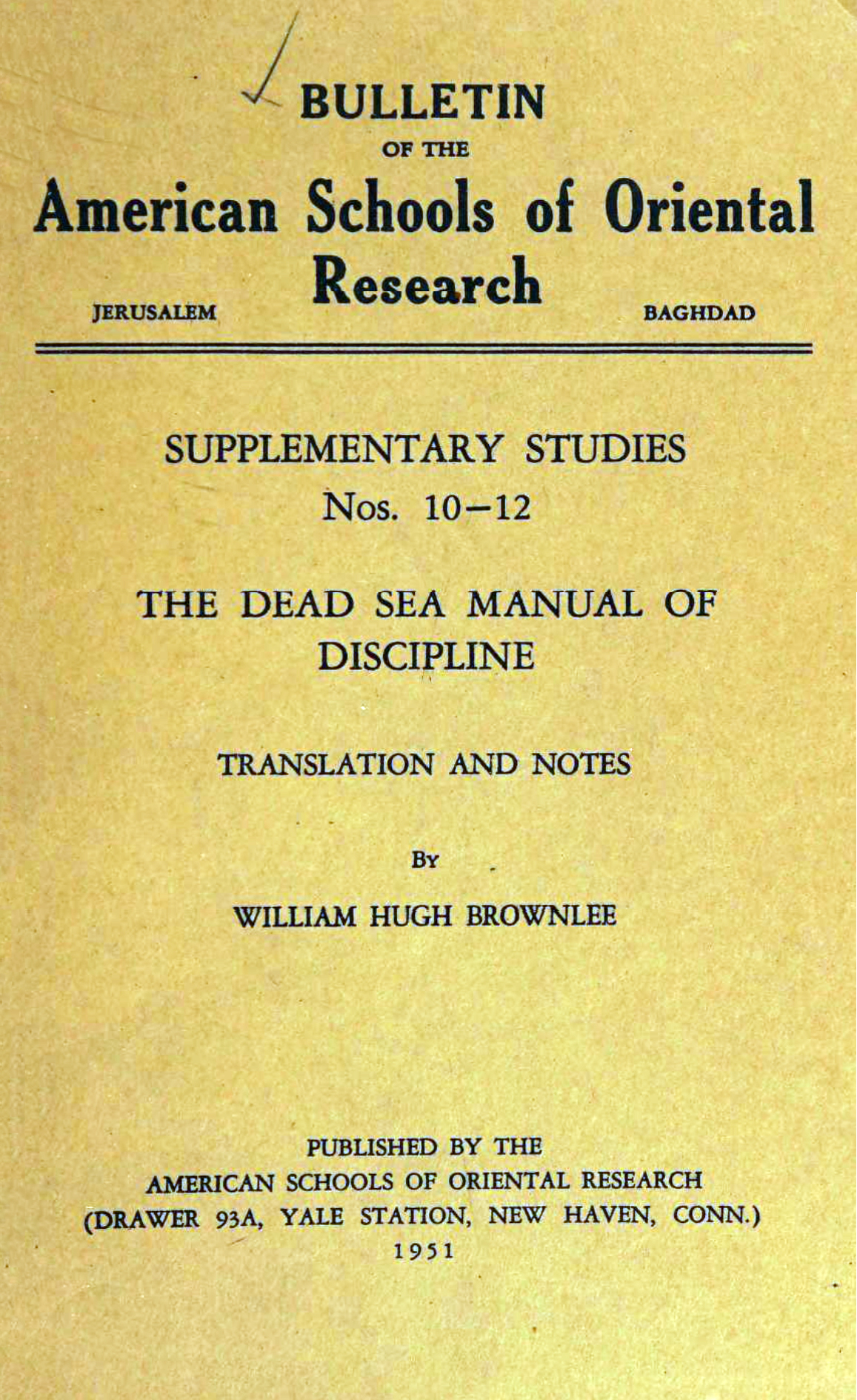
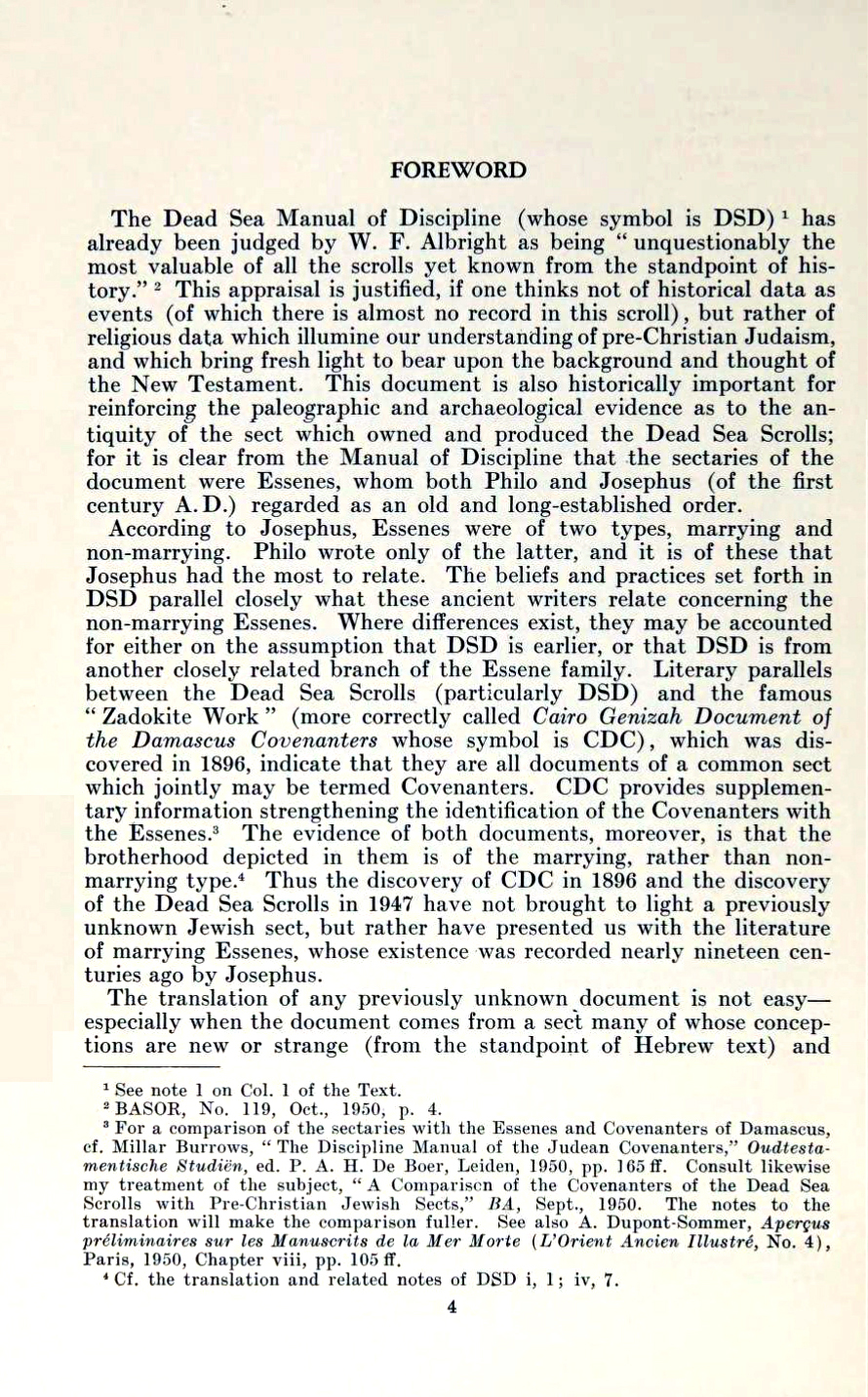
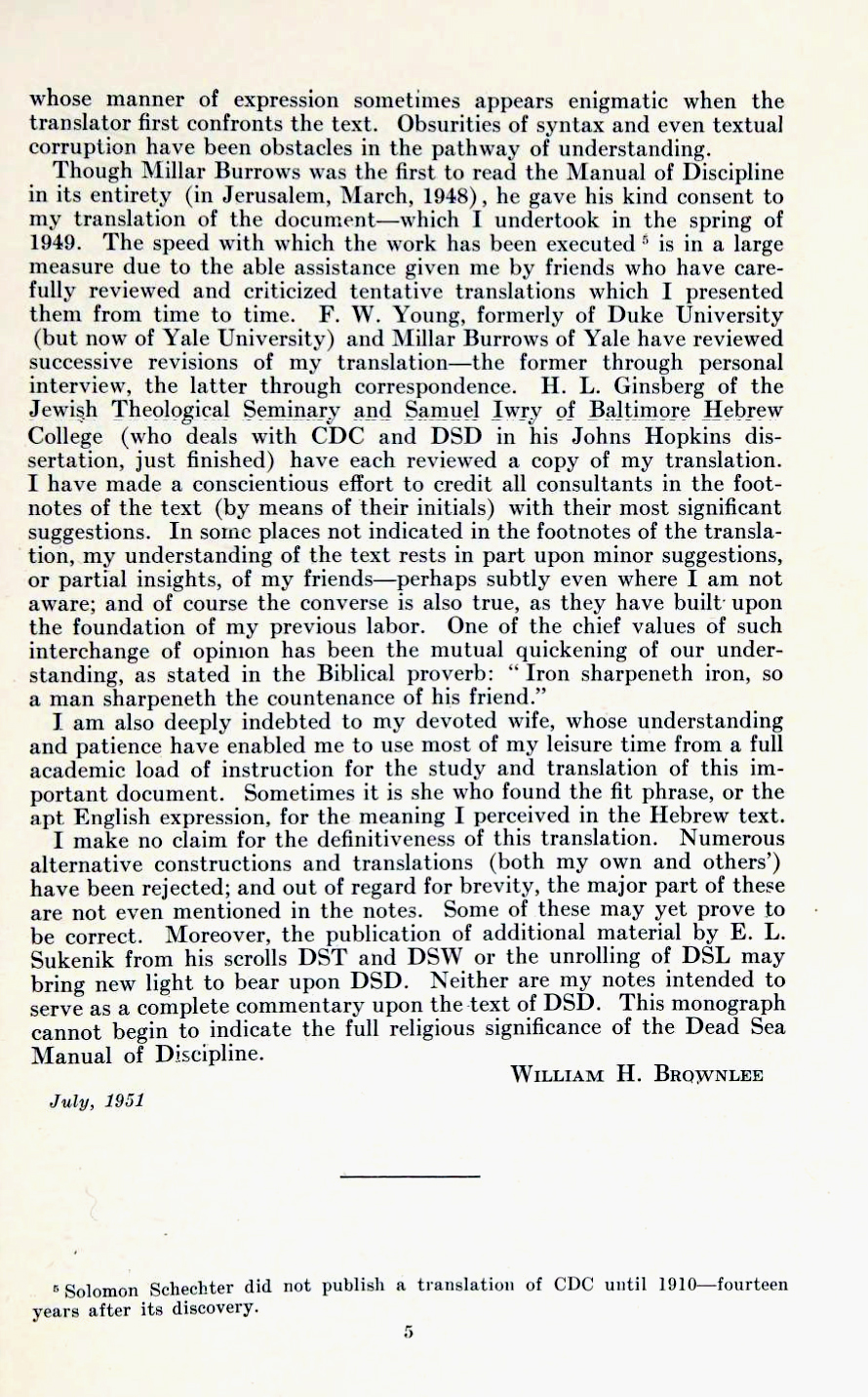
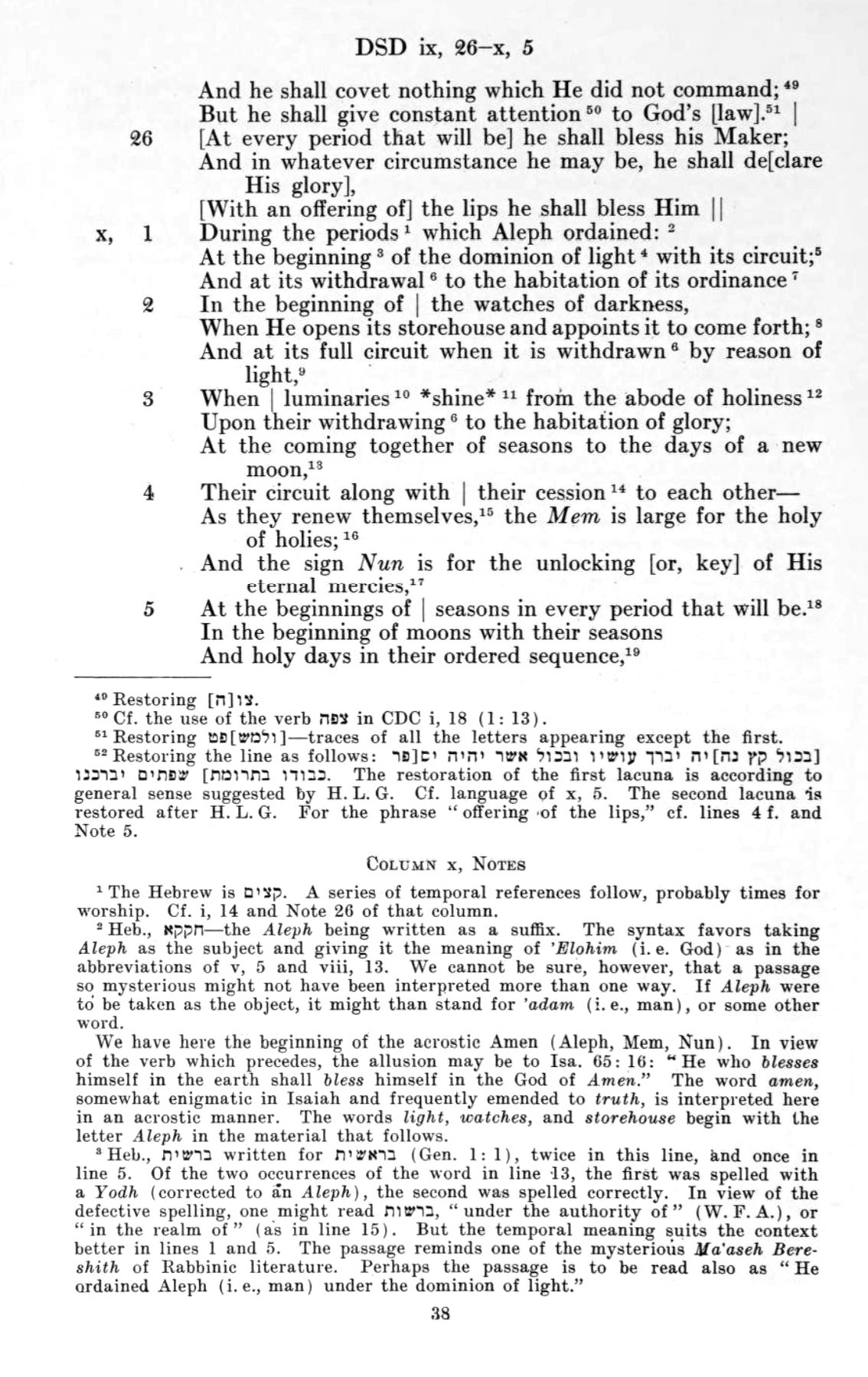
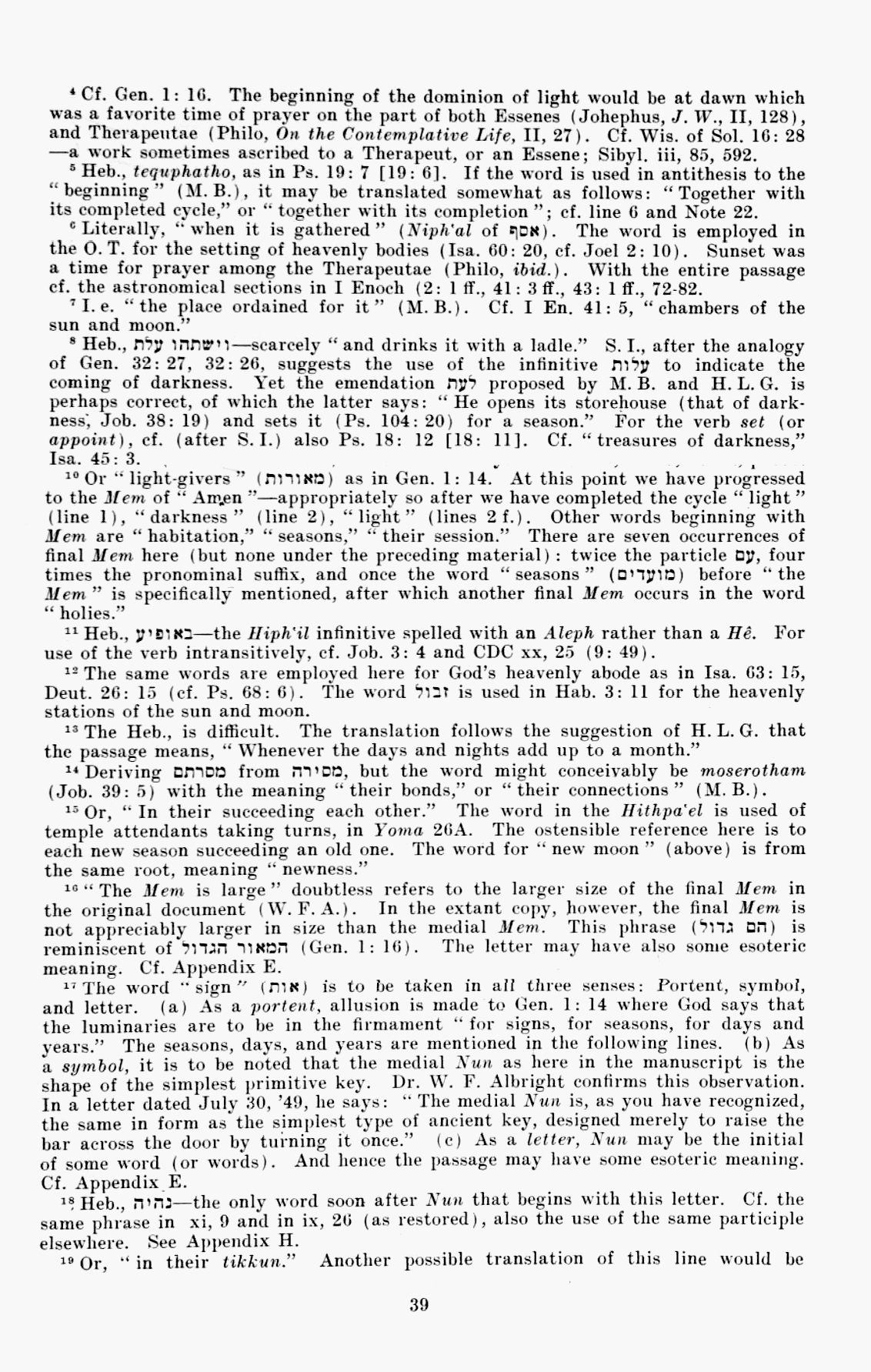
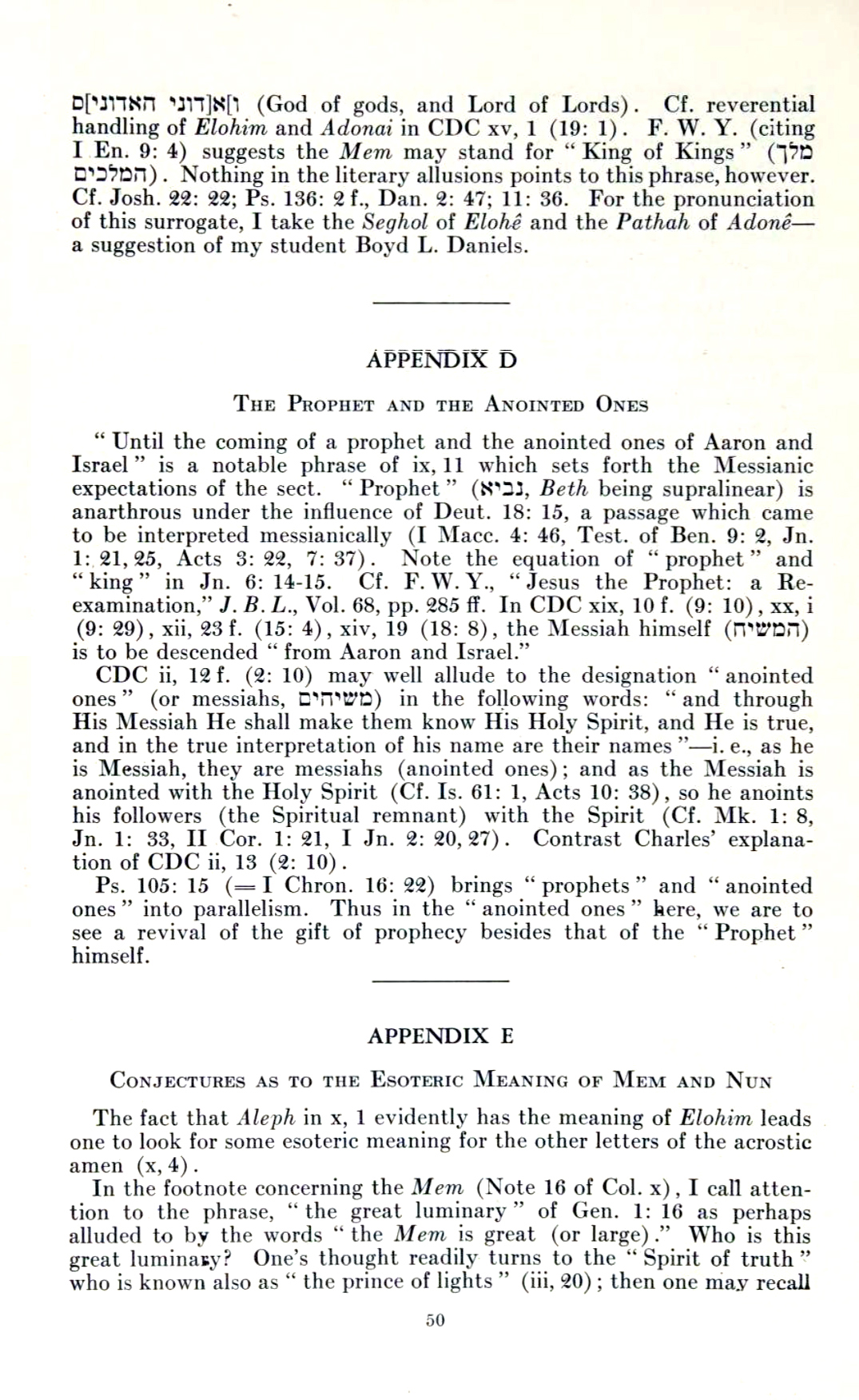
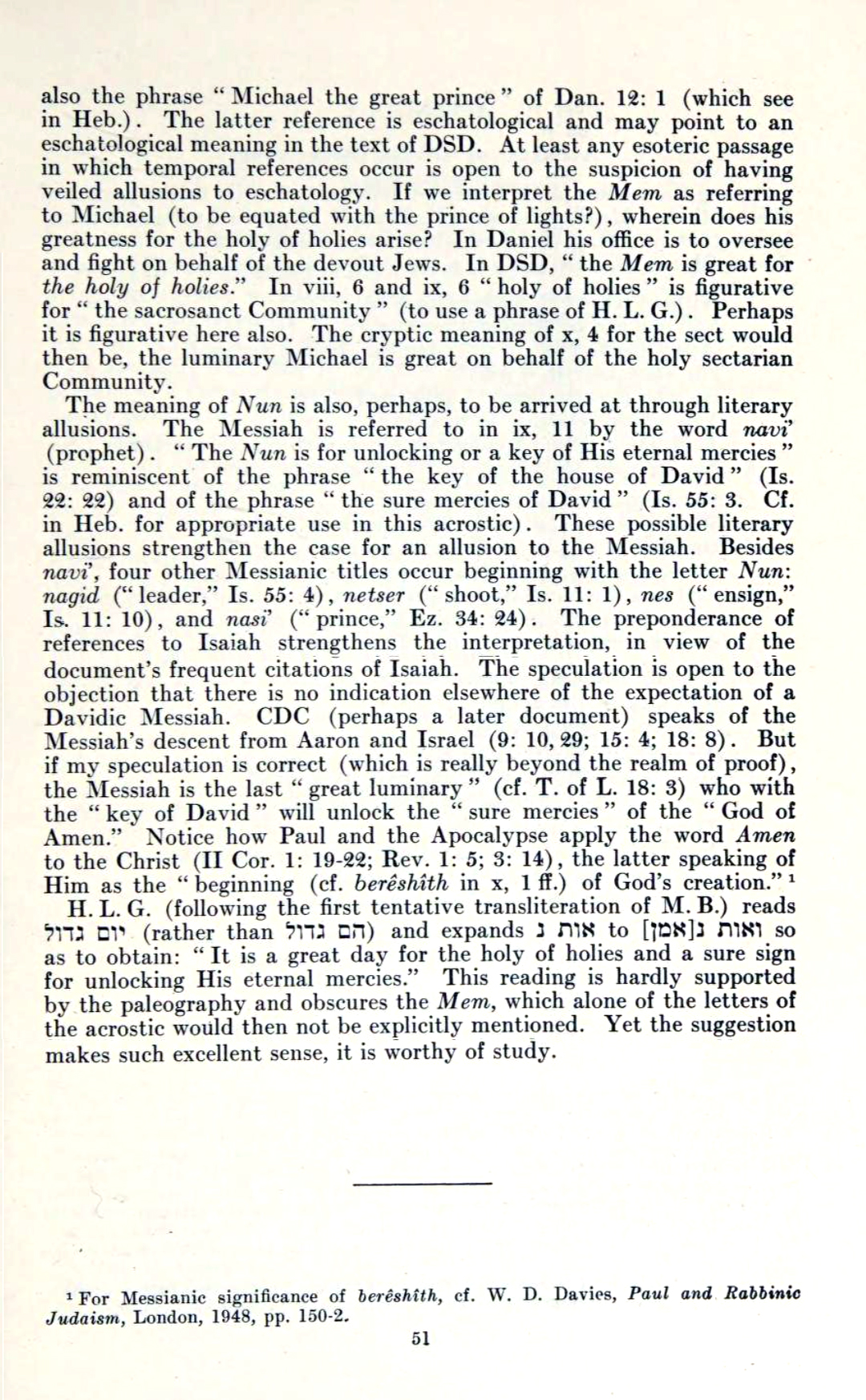
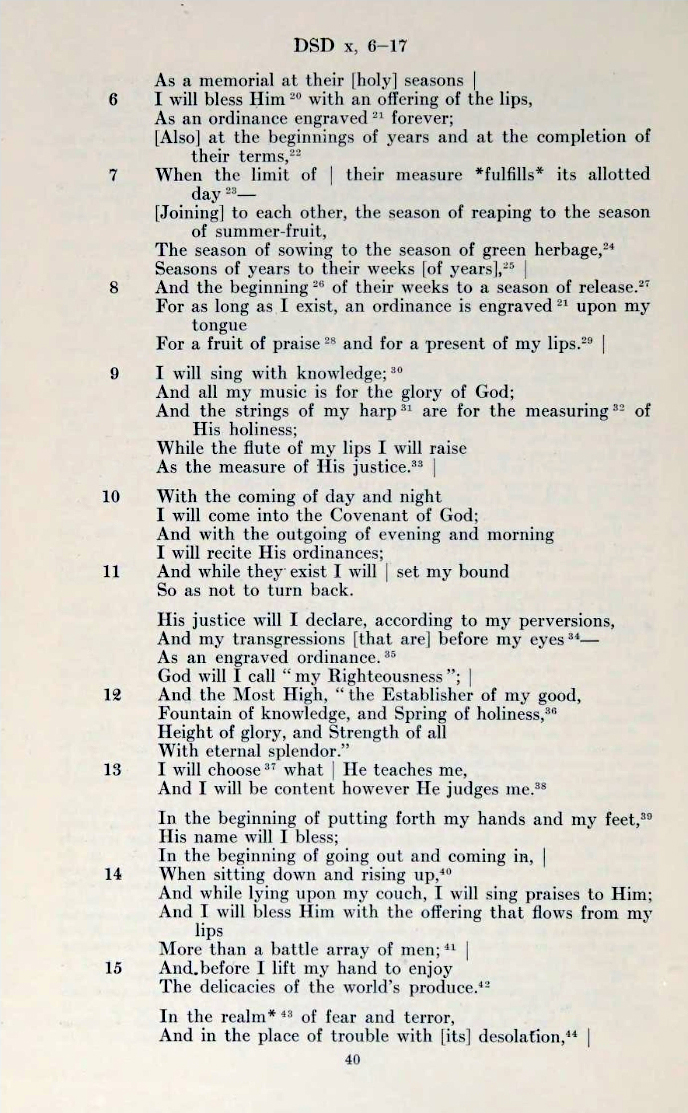
ABOVE: Pages 4, 5, 38-39, 50-51, plus cover. Brownlee, William Hugh, and W. F. Albright. “The Dead Sea Manual of Discipline: Translation and Notes.” Bulletin of the American Schools of Oriental Research. Supplementary Studies, no. 10/12 (1951): 1–60.
The pages above are from the Internet Archive. However, the full document is also online at JSTOR.
Brownlee’s Translation
Of the Acrostic Segment
x, 1 During the periods1 which Aleph ordained:2
At the beginning3 of the dominion of light4 with its circuit;5
And at its withdrawal6 to the habitation of its ordinance7
2 In the beginning of ǀ the watches of darkness,
When He opens its storehouse and appoints it to come forth;8
And at its full circuit when it is withdrawn6 by reason of light,9
3 When* ǀ luminaries10 *shine*11 from the abode of holiness12
Upon their withdrawing6 to the habitation of glory;
At the coming together of seasons to the days of a new moon,13
4 Their circuit along with ǀ their cession14 to each other—
As they renew themselves,15 the Mem is large for the holy of holies;16
And the sign Nun is for the unlocking [or, key] of His eternal mercies,17
5 At the beginnings of ǀ seasons in every period that will be.18
In the beginning of moons with their seasons
And holy days in their ordered sequence,19
As a memorial at their [Holy] seasons ǀ (from the top of page 40)
— COLUMN X, NOTES —
1.